The Film Club Question That Gets Everyone Talking
A film club question about one specific choice invites quieter viewers in and gives the group a useful way to discuss how a film works.
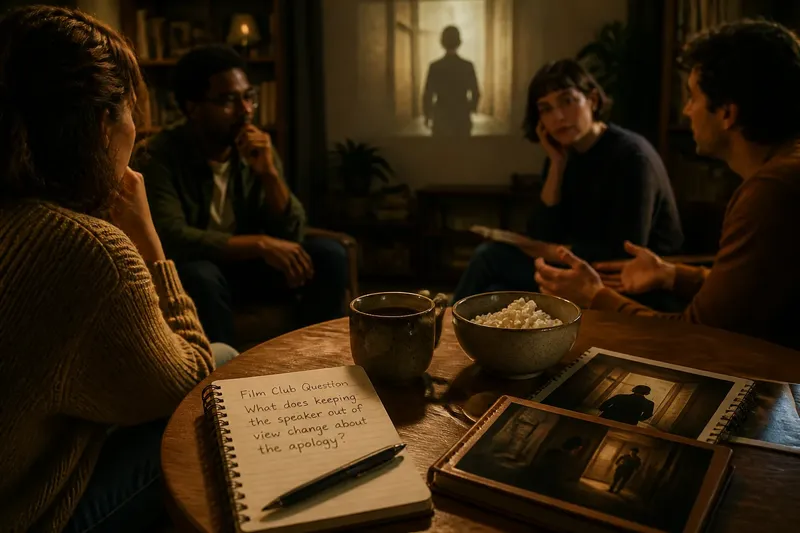
A good film club question points to one choice on screen and asks what that choice does. Instead of asking everyone to rate the film, try asking why a character leaves a room before answering a difficult question. The narrower prompt gives people something concrete to notice, while leaving room for different interpretations.
Choose a moment people can picture
Start by selecting a scene, gesture, sound, cut, or object that the group can remember without needing a complete plot recap. A useful choice has enough detail to discuss but does not demand specialist vocabulary. A pause before a reply, a song that continues across a scene change, or a character framed at the edge of the image can all work.
Keep the prompt attached to what the film actually presents. “What changes when the camera stays outside the doorway?” invites people to discuss a visible choice. “What does the director believe about family?” asks the group to jump from one moment to a broad claim about intention.
If you are choosing before the screening, note a few candidate moments while watching. If you are choosing afterward, ask the group to name a scene they keep thinking about, then select one detail from it. Avoid a moment whose only interest depends on a plot twist that would spoil the film for a newcomer.
Turn the detail into an open question
Build the prompt around a specific choice and its effect. Questions beginning with “What changes when…?”, “How does it feel when…?” or “What do you notice about…?” often invite observation before judgment. The point is not to ban opinions; it is to give people a shared detail to respond to before they decide what they think.
For instance, imagine your group has just watched a drama in which the lead character’s face remains offscreen during an apology. You might ask, “What does keeping the speaker out of view change about the apology?” One person may focus on the listener’s reaction, another on the voice, and someone else may say the absence makes the apology feel evasive. The scene gives the discussion a common anchor without dictating a single answer.
Try to ask one question at a time. If you combine the camera angle, the character’s motive, the music, and the ending in one prompt, people may not know where to begin. You can keep follow-up questions in reserve, but let the first question breathe.
How do you keep the prompt welcoming?
What if someone has not seen the detail you mean?
Describe the moment briefly without implying that everyone should remember it. If the screening setup allows, replay a short excerpt; otherwise, give a neutral reminder of what happens immediately before the choice. Then ask what people noticed, rather than quizzing them on exact details.
Should the group agree on what the scene means?
No. Ask what in the scene supports each reading, and let different interpretations remain in conversation. A useful discussion can clarify why people respond differently without settling on one official meaning.
What if the first answer is simply “I liked it”?
Accept the reaction, then invite a detail: “Was there a sound, look, or cut that helped it land for you?” This follow-up treats enjoyment as a starting point rather than a wrong answer and gives the speaker an easy way to say more.
How can a quieter viewer join in?
Offer a brief pause before calling on anyone, and let people jot down a thought or discuss it with a neighbor first. Avoid treating silence as lack of interest; a few seconds to form an idea can make the room easier to enter.
Give the conversation room to develop
After asking the prompt, wait. Resist the urge to answer it yourself or immediately name the interpretation you find most persuasive. If the first response is brief, invite another observation with a simple “What else did you notice?” or connect two comments by asking how they fit together.
When discussion drifts toward a general verdict, bring it back gently to the chosen detail. If someone says the film was “too slow,” you might ask which pause or repeated action shaped that feeling. This keeps the conversation grounded without dismissing a viewer’s response.
As facilitator, make space for disagreement without turning it into a contest. Ask participants to point to the scene, sound, or performance that informed their reading. You do not need to resolve every difference; sometimes the most useful result is that the group sees how one choice can create distinct experiences.
Close by carrying one observation forward
Near the end, ask each person to name one detail they will remember or one interpretation they want to keep considering. This is not a final vote on the film. It lets the conversation land on what people noticed, including ideas that emerged only after someone else spoke.
For your next film club question, write down the exact moment and the wording that opened discussion. The useful record is not a score or consensus, but a prompt that helped people look closely and listen to one another. A well-shaped film club question can turn a familiar scene into a shared discovery without asking anyone to defend a verdict.