An Archive Is Not Just a Room Full of Old Films
An archive is not just a room full of old films: see how selection, description, and context help a neighborhood collection become usable.
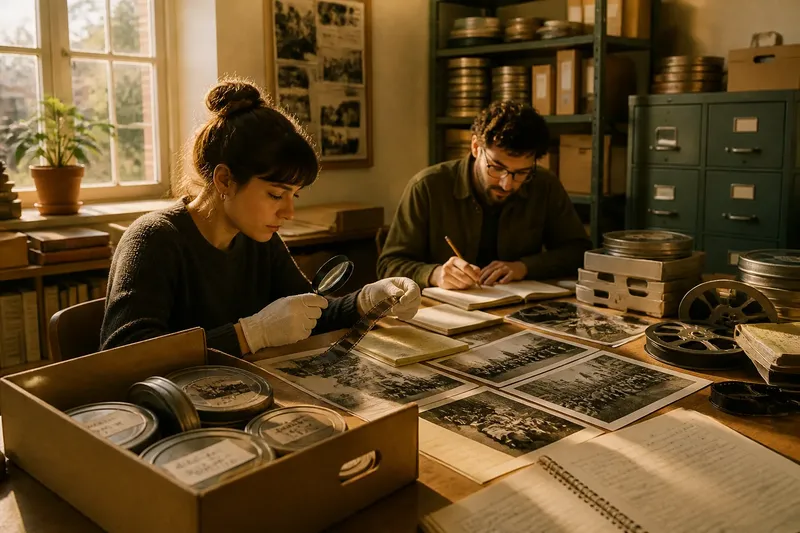
An archive is not just a room full of old films; it is the work that lets someone find a particular image and understand what they are seeing. Imagine a neighborhood arts center inheriting a box of films made during local parades, school performances, and street fairs. The reels are safe on a shelf, but their labels are vague, their creators are unknown, and nobody can tell which scenes belong to which event. The collection exists physically. As an archive, it is not yet doing much for anyone.
The center’s first useful decision is not to digitize everything or build a public website. It is to ask what the collection contains, what can responsibly be made accessible, and what information will help people make sense of it. That shift—from keeping objects to shaping access—shows why an archive is more than a storage room.
What can the center say it is preserving?
The staff begin by describing the collection’s scope. They learn that the box holds amateur films connected to public events in the neighborhood, but not every reel has a known date or maker. A few labels mention a school or street name. Others say only “summer” or “parade.” The center can state what it can verify without filling the gaps with guesses.
This first account matters because an archive is shaped by selection. The center has to decide which materials belong in the collection, which items need further attention, and which items fall outside its purpose. Those decisions are not neutral. If the staff keep only polished films with clear labels, they may exclude rough footage that contains the most useful record of an overlooked event.
Selection also means recording what is absent. Perhaps the box contains footage of a parade but no program, or a school performance without a list of performers. Naming these limits helps future users distinguish between “the archive has no record of this” and “this never happened.” The collection’s boundaries should be visible rather than disguised as a complete account of neighborhood life.
For the center, a brief scope statement might say that it preserves moving images made by local residents or organizations about public life in the area, while noting that the current group of films is incomplete and unevenly identified. That statement gives staff a reasoned basis for decisions about additions and description. It also gives visitors a fair expectation of what the collection can answer.
How does a vague reel become findable?
Next, the center creates a basic record for each item. A record is a structured description attached to a film, not simply a label copied from its can. The staff note the title as written, if there is one; a short description of visible content; any known creator or source; the physical or digital form; and what remains uncertain. They keep observed facts separate from interpretations.
That distinction can be small but consequential. If a handwritten label says “Main Street,” the record can preserve that wording while describing the visible scene as a group of marchers passing storefronts. It should not name a specific parade unless another source supports that identification. A searcher may recognize the event later, and the record can be updated with the basis for the new information.
Descriptions need useful language as well as careful restraint. A record that says only “old film” tells a visitor almost nothing. Terms such as “marching band,” “school assembly,” or “street procession” may help someone discover the footage, provided they accurately describe what appears. Names of places and organizations can also connect separate films, but staff should distinguish a documented location from a possible one.
Say the center finds a reel labeled “Field Day” and sees children racing on a school lawn, with a distinctive clock tower in the background. Staff record the label, describe the races, and note the tower as a visual clue rather than naming the school immediately. A former teacher later identifies the location and explains that the footage came from a particular school’s event. The center can add that information, note who supplied it, and make the reel easier to find for people searching by school or event.
The result is not merely a longer description. It is a record that shows how knowledge entered the archive and what can still be checked. That provenance—the account of where an item came from and how information about it was gathered—helps users judge the description rather than treating every catalog phrase as equally certain.
Why does context change what a viewer understands?
A moving image does not explain itself. A silent shot of people gathering outside a building might show a celebration, a demonstration, a routine departure, or something else entirely. The image offers evidence, but viewers need context to interpret it responsibly.
The center therefore looks for related materials: a printed event program, a community newsletter, a school yearbook, or notes donated with the films. These sources can establish names, locations, and circumstances that are not visible on screen. They can also disagree. If a program names one event and a handwritten note names another, the archive should preserve that disagreement instead of quietly choosing the tidier story.
Context also includes information about how a film was made and circulated. A camera operator may have filmed for a family, a local organization, or an event organizer. A film might be an edited compilation rather than continuous coverage. If the center does not know these details, it can say so. A measured description is more useful than a confident narrative built on assumptions.
Access decisions belong in this work too. Some material may include children, private moments, or people who did not expect their images to circulate beyond a small audience. The center considers the circumstances of creation, any known permissions, and the needs of people represented before offering public viewing. Where rights, privacy, or local rules are unclear, staff seek qualified guidance rather than treating digitization as automatic permission to publish.
Making a viewing copy can help protect a fragile original, but the copy should not erase the difference between the two. The archive can identify what viewers are seeing, explain whether the image has been edited or transferred, and retain a connection to the source item. If a section is missing or the image is difficult to interpret, that condition belongs in the description, not hidden behind a polished presentation.
What questions help an archive make better descriptions?
Should the center transcribe every label exactly?
It should preserve the wording that appears on the can or accompanying material, including uncertainty and unusual spelling when relevant. A separate description can explain what staff observe without silently correcting or expanding the original label.
What if nobody knows who made a film?
The record can identify the creator as unknown while naming any known donor or source. Those roles are different: the person who gave a film to the archive may not be the person who filmed it.
Can viewers help identify people or places?
Yes, if the center provides a clear way to submit information and records where a claim came from. Staff should review suggestions before adding them as established facts, particularly when an identification could affect someone’s privacy or reputation.
Does digitizing a reel make it archival?
No. A digital copy can improve access, but it does not supply selection criteria, description, context, or reliable records about the source. The archive still needs to document the relationship between the copy and the original film.
How does the center know whether its work is useful?
The staff review the records by trying ordinary search tasks. Can someone locate a film by the school name, event type, or street if that information is supported? Can a visitor tell which details come from a label, which come from viewing, and which came from a later contributor? These questions reveal gaps more clearly than a shelf arranged to look orderly.
They also invite people with relevant knowledge to respond. A former student may recognize a stage backdrop; a neighborhood organization may have a program that clarifies an event. The center treats such contributions as additions to the record, not as reasons to rewrite the film’s history without explanation. A note about who supplied information and when it was added keeps the description open to revision.
For this imagined arts center, the box has not become valuable because every reel now has a perfect title. Its value grows because the staff can explain what they selected, describe what they know, identify what they do not know, and connect images with evidence and community knowledge. The films become easier to discover without pretending that their meaning is settled.
That is the practical test of an archive: can a person approach an image, locate the evidence around it, and understand the limits of what it can tell them? An archive is not just a room full of old films. It is the continuing description and care that makes each film legible, shareable, and open to better understanding.